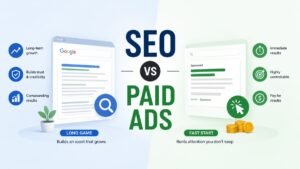
SEO vs paid ads: which reduce your marketing cost?
There's no universal winner. There's only the right answer for your specific situation and this guide will tell you exactly what that is.
You've got a marketing budget and two options in front of you. Invest in SEO, or run paid ads. Both promise results. Both cost real money. And almost everyone you ask gives you a different answer.
Your web developer says SEO. Your friend who runs Facebook ads says paid is faster. A blog post you found says "it depends." And none of them actually help you make the decision.
"Most comparisons pick a winner and argue for it. That's not how this works. The right answer depends on your specific situation and three things about your business will tell you which one it is."
This guide covers how each channel actually works, what makes them different, and most importantly — a decision framework you can apply to your own business right now. No agenda. No winner declared upfront. Just the honest answer.
How SEO actually works
SEO is the process of making your website rank higher in Google's organic results — the listings that appear below the ads, which most people click more often and trust more readily.
You do this by creating useful, well-structured content around the terms your customers are searching for, making your site fast and technically sound, and earning links from other credible websites. Google rewards pages that genuinely answer what people are looking for.
The catch is time. Most businesses don't see meaningful movement for three to six months. Google needs to crawl your site, index your content, and build confidence in its relevance before it starts showing you to more people. It's not a switch you flip — it's a foundation you build.
The payoff, though, is significant. Every piece of content you optimise keeps working after you publish it. A blog post you write today can bring in qualified leads two years from now — without any ongoing spend. That's the compounding effect that makes SEO so valuable over time.
For a deeper breakdown of how SEO works and what it involves, our plain English SEO guide covers it in full.
How paid ads actually work
Paid ads — Google Ads, Meta Ads, LinkedIn Ads — put your business in front of people immediately. You pay each time someone clicks your ad, sees it, or takes an action. The moment you launch a campaign, you can have visitors on your website.
Google Ads targets people who are actively searching for what you offer. Meta Ads (Facebook and Instagram) targets people based on who they are — their interests, demographics, and behaviour. Both can work well; the right choice depends on where your customers spend their attention.
The fundamental difference from SEO is this: paid ads stop the moment your budget does. There's no compounding. No asset built over time. The day you pause the campaign, the traffic stops. You're renting attention rather than earning it.
That doesn't make ads bad — it makes them a different tool. Fast, controllable, measurable, and excellent for specific situations. The question is whether your situation is one of them.
SEO vs paid ads
- Takes 3–6 months to see real movement
- Traffic compounds month on month
- Cost per lead decreases over time
- Rankings stay even if you reduce spend
- Builds credibility and trust with searchers
- Best ROI over a 12+ month horizon
- Results visible within days or weeks
- Traffic stops when budget stops
- Cost per lead stays flat or rises
- No lasting asset — spend restarts each cycle
- Excellent for testing new offers quickly
- Best ROI for urgent or time-sensitive goals
| Factor | SEO | Paid Ads |
|---|---|---|
| Time to results | 3–6 months | Days to weeks |
| What happens if you stop | Rankings mostly hold | Traffic stops immediately |
| Cost over time | Decreases per lead | Flat or increases |
| Trust signal | High — organic results are trusted | Lower — marked as "Sponsored" |
| Control | Lower — Google decides when | High — you control spend, timing |
| Good for testing | No — too slow for quick tests | Yes — fast feedback on messaging |
| Good for long-term growth | Yes — best channel for this | Not alone — needs SEO alongside |
Which is right for your business? Use this matrix
Answer honestly: which of these situations describes you right now? The right channel follows from the situation, not from which one sounds more impressive.
| Your situation | Channel | Why |
|---|---|---|
| New business — you need leads in the next 30–60 days | Paid ads | SEO takes months you don't have. Ads give you pipeline fast and let you test what messaging converts. |
| Established business with steady revenue wanting sustainable growth | SEO | You have runway. Invest in an asset that compounds and reduces your cost per lead month over month. |
| Seasonal business with a short selling window | Paid ads | You need volume in a specific window. SEO can't be turned on and off — ads can. |
| Local service business targeting customers nearby | Both — start with SEO | Local SEO and Google Business Profile are high-impact and low-cost. Build that foundation first, then add ads to amplify it. |
| Launching a new product or service nobody has searched for yet | Paid ads | SEO can't drive demand that doesn't exist yet. Ads reach people who don't know they need what you offer. |
| Previously burned by ads, working with a limited budget | SEO | A small ad budget is easily wasted without expertise. SEO investment builds value even with a modest monthly spend. |
| Ready to build a proper marketing engine for the long term | Both — in the right order | SEO for the organic baseline and compounding growth. Ads for testing, seasonal spikes, and accelerating what's already working. |
Most established businesses should use both — in the right order
This isn't a cop-out. It's a strategic argument that most marketing advice skips.
SEO builds the foundation. It's the content, the authority, the technical credibility that tells Google your site deserves to be seen. This takes time but creates something permanent — a growing library of content that brings in qualified visitors without ongoing spend.
Paid ads amplify what's already working. Once you have landing pages that convert, messaging that resonates, and a site that Google trusts — ads become dramatically more efficient. You're spending money on a proven system, not guessing whether the destination will close the deal.
Running paid ads on a website that doesn't convert is expensive and demoralising. You'll spend your budget sending people to a page that loses them — and conclude that ads don't work, when the actual problem was the destination.
"Build the foundation first. Fix what the website is doing wrong. Then decide which channel or combination — to use to amplify it."
This is why our case study always starts with the technical audit before any traffic strategy. The channel is secondary to whether the destination is ready to receive it.
Both SEO and paid ads waste money on a website that doesn't convert. Before committing budget to either channel, run through our free 25-point website audit checklist. It takes 20 minutes and will tell you whether your site is ready to receive the traffic you're planning to send it.
Let's figure it out together in 30 minutes
Book a free strategy call. We'll look at your specific situation — your goals, your timeline, your current site and tell you exactly which channel makes sense and what a realistic plan looks like.
Book your free strategy call →No pitch. No commitment. Just a clear answer and a direction.